Circular slide rule based on Bürgi’s Logarithm Tables of 1620

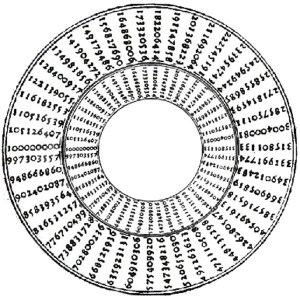
 The book The Construction of Mathematics: The Human Mind’s Greatest Achievement includes creation of tables of the logarithm function by the Swiss craftsman, engineer, and mathematician Jost Bürgi around 1600 CE, with delayed publication in 1620. The book includes the title page of Bürgi’s tables, then explains that the black numbers of the inner ring are on a logarithmic scale.
Due to that feature, two copies of that ring of numbers can be arranged in nested fashion depict a circular slide rule.
Bürgi did not realize this, or rather, there is no evidence that he did. Instead, William Oughtred invented the circular slide rule two years later, in 1622.
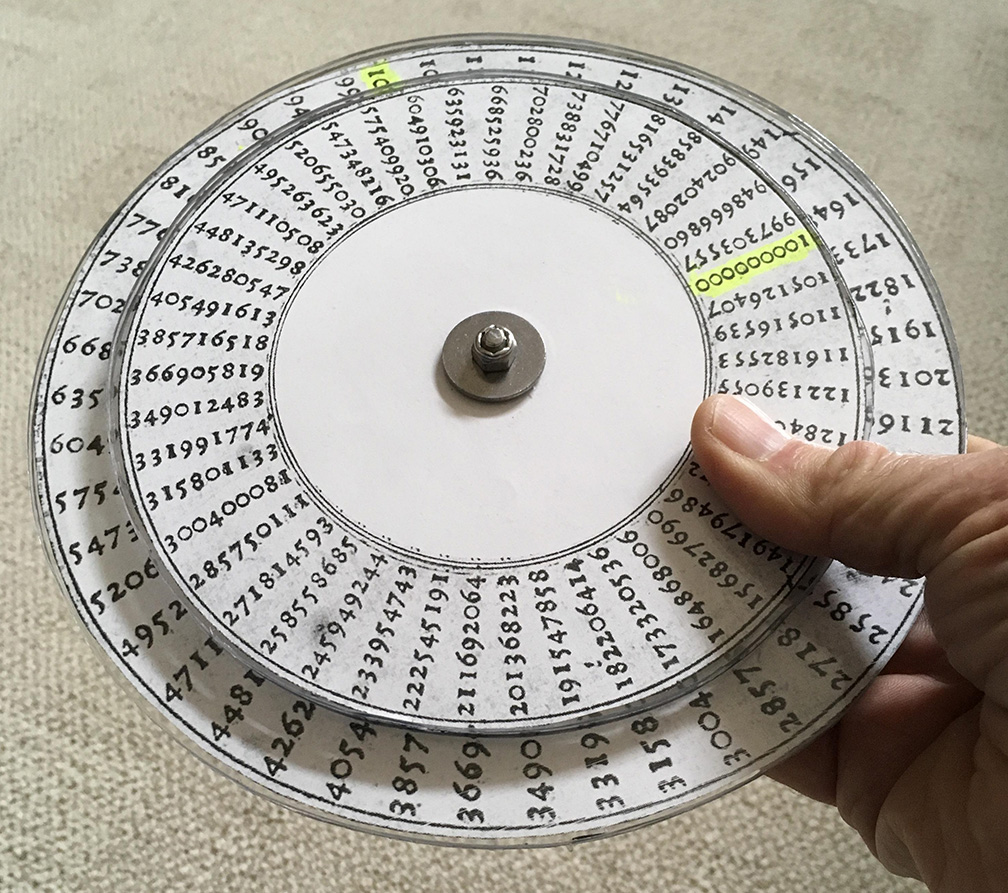
We couldn’t rest until we had implemented the circular slide rule based on Bürgi’s title page. For an authentic look, we created with Photoshop two differently sized copies of the black ring of numbers of Bürgi’s title page. The resulting rings were encased in Lexan and connected by a center bolt. It is fun to multiply and divide numbers by rotating the inner, smaller disk, all the time thinking that this is based on the work of genius done almost 400 years ago.
 Klaus Truemper
How does one use this? Can you give brief instructions on how to turn it to get calculations? thank you
LikeLike
Here is a simple example for multiplication. Suppose you want to multiply 2 times 3. You rotate the inner disk so that the 1000. . . of the inner disk points to 2000. . . on the outer disk. Well, we don’t see that number there, but there is something close: 2013. . . Now walk along around the inner disk clockwise until you reach 3000. . . That number isn’t there, either, but 3004. . . is close. At that point, you read the corresponding number on the outer disk. It is 6049. . . Introducing decimal points, we have 2.013 times 3.004 is approximately equal to 6.049. Of course, all this is not very accurate, and one would need to create a precise version of the two disks. But the principle is clear: Multiplication has become a simple addition of distances marked on two disks.
For division, one uses subtraction of distances. That is, to divide 6 by 3, one places the 3 of the inner disk at the position of the 6 on the outer disk, then moves to the 1 on the inner disk and reads off the solution 2 on the outer disk.
Given Bürgi’s skill with precision scales, doesn’t this discussion make it obvious that he most likely saw this? The only explanation why he didn’t pursue this is then that in his opinion the method wasn’t precise enough. A major oversight that ignored that engineers and scientists often are content to get approximate results for complicated computations.
LikeLike